
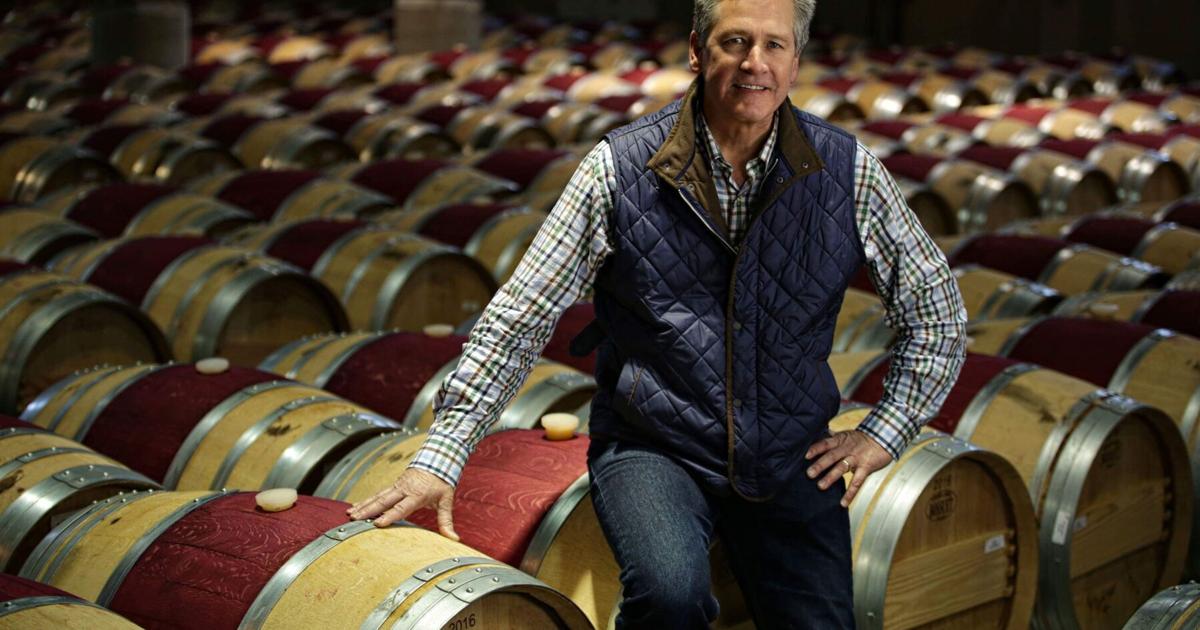
Judd Wallenbrock’s goal: To make Charles Krug one of the world’s great wine estates | Wine Leave a comment
In mid-2017, Judd Wallenbrock was hired as president and CEO of C. Mondavi & Family, the parent company of Charles Krug Winery, the oldest winery in Napa Valley, and its mass-market brand, CK Mondavi.
It must have seemed ironical to him. Wallenbrock has already worked for the other side of the Mondavi family, and both families had once been united at Krug.
Support local news coverage and the people who report it by subscribing to the Napa Valley Register.
It was a turbulent time when Wallenbrock came aboard. The proprietors, Marc Mondavi and Peter Mondavi Jr., had fired its board and CEO, and many executives had left. “It looked like rats deserting a sinking ship,” said Wallenbrock, “but it was great for me. I was able to bring in my own team.”
That also gave Wallenbrock a chance to implement his vision: To make Charles Krug one of the world’s great wine estates. His background could have been designed to do just that.
Not born into wine
Wallenbrock was raised in San Marino, an exclusive enclave near Pasadena, and his family was comfortable but not wealthy. His passion was baseball, not wine, and he played while he was at UCLA. Unfortunately, his father had business reverses in his sophomore year. “He said, ‘You’re on your own,'” Wallenbrock recalled
People are also reading…
Though UCs weren’t that expensive then, he recognized that his chances of a career in professional baseball were slim and his major, political theory, didn’t hold a lot of promise for jobs, either.
He decided to transfer to Cal Poly at San Luis Obispo and study agricultural business. “I knew people would always have to eat,” he joked. He put himself through school.
Although his family wasn’t into wine, his older brother, noted baseball player Craig Wallenbrock, was. Judd made his first trip to Napa with him when he was 16 in 1974 and wineries happily poured tastes for him, although he admitted, “I looked 12.”
A conscious decision
That visit was enough to convince Wallenbrock. He vowed he’d make a career in wine.
For about a decade, he worked in retail, restaurants and as a wine broker. He learned one thing well: “The wine business was all about production and sales. What was missing was the pull, how to create demand.” And that determined his direction.
He took a break to earn his MBA, then spent four years at Carnation, part of consumer giant Nestle, forging a marketing discipline in consumer packaged goods, and an acute desire to bring that discipline into the wine industry.
Nestle then owned Wine World, which is now mostly Treasury, and his goal was to spend five years there and run Beringer.
Joining the first Mondavi winery
In the meantime, he met Martin Johnson, the vice president of marketing at Robert Mondavi Winery, who hired him to develop brand management.
In those days, Mondavi owned a number of other brands: Bichon, Byron, Opus, and the old lower-end Mondavi brands — “Bob White” and “Bob Red — that Wallenbrock helped turn into Woodbridge.
“In those days, there was a lot of baiting and switching in restaurants. People would order Robert Mondavi, but what they got was a wine from Lodi.”
Wallenbrock learned that having the same name on low-end wines and better ones was not only deceiving but bad for the high-end brand.
In the nine years he was at Robert Mondavi Winery, he held five jobs, four of which he created to serve a need.
The company entered joint ventures in Chile, with Frescobaldi in Tuscany and with Arrowhead. “We were dividing the company into two parts, the Robert Mondavi family of wines and the others.”
Wallenbrock became head of marketing for all the brands, and vice president of Central Coast operations.
In 1994, however, Mondavi went public and he felt the culture change by 1997.
On his own
Wallenbrock left Robert Mondavi Winery in 2001. “I was ready to run my own company, but I needed a unique proposal.”
He figured one out, but while seeking financing, became vice president of sales and marketing at DeLoach Vineyards in Sonoma County, which was sold to Jean-Charles Boisset.
He then became president of nearby Michel-Schlumberger Estate, where he turned the company’s sales from 90% wholesale and 10% direct to consumer to the reverse. Then it was sold, too.
Meanwhile, Wallenbrock had lived in Browns Valley for 26 years, and he was tired of commuting to the Russian River.
He observed that wine companies, unlike consumer product companies, are typically asset-rich and cash poor. Raising cash to create a new company, he started Humanitas, the Good Life Wine Collective, in 2000.
Wallenbrock based Humanitas on doing good. The name was inspired by Robert Mondavi’s vision of the good life. Eventually, partners and doctors who financed it merged it with Jessup Cellars and Handwritten Wines, then shut down Humanitas.
No shortage of successors but no clear vision
When Wallenbrock joined C. Mondavi in 2017, he felt that the winery didn’t have a vision — except to never sell out.
“My job was to build the business to turn it over to the next generation, the fourth since Rosa and Cesare bought the property in 1943.”
That generation included Marc’s four daughters and Peter Jr.’s daughter and son. And the first of the fifth generation was just born.
The family encourages members to work elsewhere before joining the family business, and only Riana Mondavi, one of Marc’s daughters, works full time at the family company right now, though the others are involved in various ways including on the board of directors.
Angelina Mondavi, the oldest of Marc’s daughters, is a respected winemaker producing wine for a number of companies. She makes Aloft and Dark Matter with her sisters Alycia, Riana and Giovanna. These wines aren’t under the C. Mondavi umbrella.
Lia and Lucio Mondavi are the children of Peter Mondavi, Jr.
All of the Mondavis are ambassadors for the entire company.
Wallenbrock runs the company (and reports to the board) so there is no pure operational role of any Mondavi with the exception of Riana, who works in sales. However, Wallenbrock said, “Peter and Marc are there every day and act as very active team members and advisors to me and my executive leadership team.”
One of the world’s great estates
To prepare the company to turn over to the next generation as owners or employees and potential executives, Wallenbrock’s goal was clear to him: “We want to be recognized as one of the world’s great wine estates.”
That goal suggested his approach. “If you ask what it takes to accomplish that, you get the answers.”
He ticks off the evidence:
• Charles Krug is the oldest still-standing winery in Napa Valley
• It is owned by Mondavis, “the first family of wine in Napa Valley.”
• It owns significant vineyard land in Napa Valley.
• It has two historical buildings.
• It makes very good wine.
Wallenbrock instills this goal in every new employee, and it has become a galvanizing cry at the company.
Krug’s plain stepsister
While Krug is most visible, the company also makes everyday CK Mondavi wine, traditionally in larger formats.
CK Mondavi wine isn’t well known in Napa Valley, where Charles Krug is the focus, but the brand was created in 1946. “Woodbridge was patterned on it,” said Wallenbrock, who help create what became Robert Mondavi’s biggest brand by volume.
Much of the fruit for CK Mondavi comes from their 1,800 acres in the Dunnigan Hills and Rolling Hills in Yolo County in Sacramento Valley, which produces excellent grapes from relatively inexpensive land. Other grapes come from family farms in Lodi and Monterey.
CK Mondavi delivers above its price, but its traditional larger format is losing favor with consumers. The company is converting production to 750-ml bottles to better appeal to the market and now 72% of production is in these standard bottles.
CK Mondavi and Family is introducing two bold wines to its lineup. Buttery Chardonnay and Dark Cabernet Sauvignon will be available nationwide this spring.
Introducing new, relevant brands
The Mondavi name (like Krug) creates some confusion and legal complexities since other prominent wineries also use them, especially in exporting, and Wallenbrock wanted to move its lower tier of wines up in the market to the sweet spot in the teens, too.
The company created Flat Top Hills wines, $15 wines instead of lower-priced bottles. Flat Top Hills wines are made by consulting winemaker Angelina Mondavi and CK Mondavi winemaker Randy Herron.
The band hits the right notes: diverse and female millennium leadership, good land and Mondavi family connections. Unfortunately, it rolled out in February 2020, just as the COVID-19 pandemic hit.
The company has reintroduced it to many markets, but more importantly, to other channels, namely on-premise as restaurants are re-opening. “It is a perfect wine by the glass,” said Wallenbrock
Looking to expand, he noted that many wineries are for sale, mostly wineries with land and production but not a strong market presence. But C. Mondavi already has plenty of assets. He seeks brands with potential but not a lot of assets.
Their newest brand is a joint venture, French Blue, based in Bordeaux. It produces one of the few rosés made there, exploiting the exploding demand for French rosé. It’s available in Whole Foods. They intend to build this business, not only the rosé but blanc and rouge.
Arts and culture add cachet
Wallenbrock also recognized that one way to become respected as a great estate is via arts and culture. “Wine is culture,” he said. “You sell wine by connecting it to something — food, people, music and the arts.”
Consequently, he has consciously sought to attract arts and culture programs to Charles Krug Winery.
That goal is possible partly because the winery — besides being grandfathered in — is within the city limits of St. Helena, not in the unincorporated county, where severe restrictions apply to activities “unrated” to actual winemaking and sales.
“We have 160 acres of the most historic and beautiful property in Napa Valley,” he said. “We want to make it the cultural hub of Napa Valley.”
Wallenbrock has been spectacularly successful in attracting these cultural events, a situation ironically boosted by the need to hold many outdoors due to Covid.
Among the activities Charles Krug has attracted include the Blue Note summer concert series, Festival Napa Valley, Nimbash Arts Gala, Music in the Vineyards. Live in the Vineyard, Cochon Napa Valley, Hands Across the Valley, Mentis fundraiser, Boys and Girls Club fundraiser and summer movies from the Cameo Cinema
Krug is also creating an art gallery upstairs in the Redwood Cellar. Arts Council Napa Valley will hold its “Beyond the Label” exhibit to highlight the Latino arts community at the winery during the summer.
The winery has also granted an easement for the Wine Trail to use its property, and the Wine Train brings visitors to the winery on tracks that end at its northern border.
The winery is even allowing PG&E to use its property for staging during the construction of a new gas line.
And what’s next?
Though the cultural activities may be most visible here in Napa Valley, Wallenbrock remains focused on the company’s prime product, its wines.
His vision from day one has remained to “strengthen the foundation” — that is, make its two core wines, Charles Krug and CK Mondavi shine.
At the same time, he wants to “optimize the franchise.” By that, he means to better utilize its land, human and financial resources by either acquiring or creating new wines consumers want, all to “keep our eyes on the prize” — always remaining family-owned by the Mondavi family.
“We are doing this very methodically and not rushing into anything,” he said. “We are letting the consumer tell us where they want us to go next.”
A 61-year-old woman was hospitalized after she was run over by her own car on Highway 29 in south Napa, police reported.
The three arrests resulted from a stabbing near Old Soscol Way and Trancas Street, according to police.
Napa Police announced the recovery of about $4,000 worth of goods stolen from the Kohl’s department store in downtown Napa.
Napa Police arrest a 35-year-old man after a knife-wielding incident in a supermarket.
A 31-year-old man’s arrest after an arson incident was his third in as many days, Napa Police reported.
