
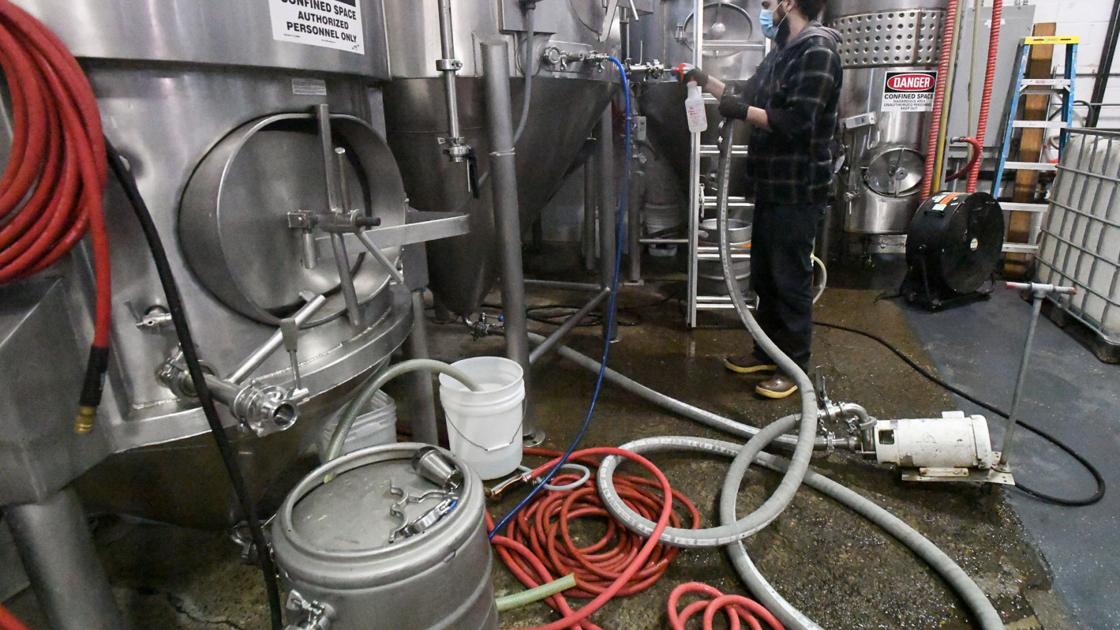
Trouble brewing: Mid-valley beer, wine and spirits affected by supply chain issues | Local Leave a comment
By now, it’s old news that mid-valley breweries and wineries were hit hard by the pandemic closures that shuttered restaurants and bars, their biggest buyers. Now, the makers of beer, wine, cider and spirits have taken another hit, this time because of supply chain snafus.
Sales reported to the Oregon Brewer’s Guild were down in 2020 and down from 2021 projections, according to a report from the Oregon Liquor & Cannabis Commission last week.
In beverage terms, that translates to about 324,000 fewer barrels of beer sold last year.
It’s all tied to the backlog of cargo ships waiting to unload amid a surge of imports. And local brewers say, while they are weathering the storm, it’s put them in a tough financial situation.
“Even before pandemic, the freight shipping was changing and the trucking world is changing,” said Sky High Brewing’s head brewer Paul Harwood. “A lot of that hadn’t hit the food industry side of things. … And now just about everything has been hit. Little by little things were changing.”
People are also reading…
The long-standing shortage of people with commercial driver’s licenses, for example, has been worsening over the span of years. But the pandemic made it come to a head faster, leading to corresponding increases in the price of shipping and hauling.
The importance of local hops
That’s why local breweries really benefit from the fact that the hops, grains and oats — the main ingredients of popular beers — can all come from Oregon or neighboring states.
“For our hops, we buy them quite locally; it’s a major crop in Oregon,” Caitlin Prueitt, co-owner of Albany-based Calapooia Brewing, said. “Prices have gone up, but I don’t know if it’s a supply issue per se.”
For specialty ingredients, particularly malts that come specifically from regions in Europe, it can take months for an order to make it to local brewers.
“I do know that the supply of specialty German malt, like Munich malt and Vienna malt, have been in shortage,” Jeff Tobin, owner of Mazama Brewing in Corvallis, said. “We wound up having to go with a different supplier.”
Tobin and others said that they believe the smaller scale of microbreweries has actually helped them adapt more easily to these constant shortages. It’s a bigger problem for big operations that rely on certain ingredients for their flagship beers, they say.
“If we were a large brewer that had very specific beers that we made year-round, it would be more of a challenge (because) you’re trying to exactly match a recipe batch to batch,” Tobin said. “But for us, the kinds of beers that are our flagships use domestic grains. We’re not seeing an issue with domestic malts.”
When ingredients can’t be sourced
That also means that seasonal beers, which may use certain kind of tropical or citrusy fruits, may be able to pivot to different flavors until the supply bounces back. Multiple brewers said that certain purees used to provide a fruity pop to beers and ciders have become harder to find.
Of course, this all trickles over to the food service side of the operation, too, as most of these breweries also operate a pub or restaurant.
“On the pub side of things, there have been a few items, like pita chips, we haven’t been able to get, and it’s been blamed on supply chain issues,” Prueitt, with Calapooia Brewing, said.
There is one area where everyone is hurting: bottles, cans and labels.
“There is an aluminum shortage in general, so that affects both the empty cans and the lids,” Tobin said. “That had an impact on us mostly in the summer of 2020, when that shortage first hit, and we’re having a hard time locking in commitments from suppliers.”
The bottle blues
Bottles are another nightmare, which is why Tobin said Mazama moved entirely away from bottling its products once the pandemic hit.
For business owners like Prueitt, however, who also owns and operates Vivacity Spirits in the same brewing complex as Calapooia Brewing operates out of, glass bottles are unavoidable for spirits packaging.
She described steep price hikes and long wait times for shipping containers of glass bottles.
“It was usually $3,000 for a container,” Prueitt said. “Now it’s $21,000. That’s going to impact the price of everything.”
Because alcoholic beverages cannot be sold without proper packaging and labels, the production lag time is downright disruptive for local brewers.
“If we can’t get labels, we can’t package and ship it,” although they can keg it, Tobin said.
“Then, we’ve got beer sitting there, waiting for labels, so we can get it on shelves. It’s definitely clogging up the works for us,” he added.
This shortage of glass bottles also hurts local wineries, and all kinds of local businesses that have been impacted say it’s due to a backup at ports all up and down the West Coast.
“Our glass is sitting out in the ocean waiting to come in; same with paper for like labels and things,” Tabitha Compton of Compton Family Wines in Philomath, said. “We just have to plan much further ahead.”
Local brewers and winemakers say they are trying to roll with the punches and keep putting out high-quality products.
“We’re just trying to keep the taps flowing, make as high quality beer as we can even if the margin is down on it,” Sky High Brewing’s Harwood said. “Because things are just rushing out the door and off the shelves. I think overall quality is down on products, so if you have a product you can make that’s really high quality, I think the customers respond well to that.”
Troy Shinn covers healthcare, natural resources and Linn County government. He can be reached at 541-812-6114 or troy.shinn@lee.net. He can be found on Twitter at @troydshinn.
